


Dachaigh #9: A tale of tenements and teuchters - what does it mean to be a “Glasgow Gael”?
- Oct 12, 2020
- 4 min read
Hey there, welcome back!
Recently, I published these tweets (see below) pertaining to some thoughts and feelings that have been brewing within me pretty much forever:
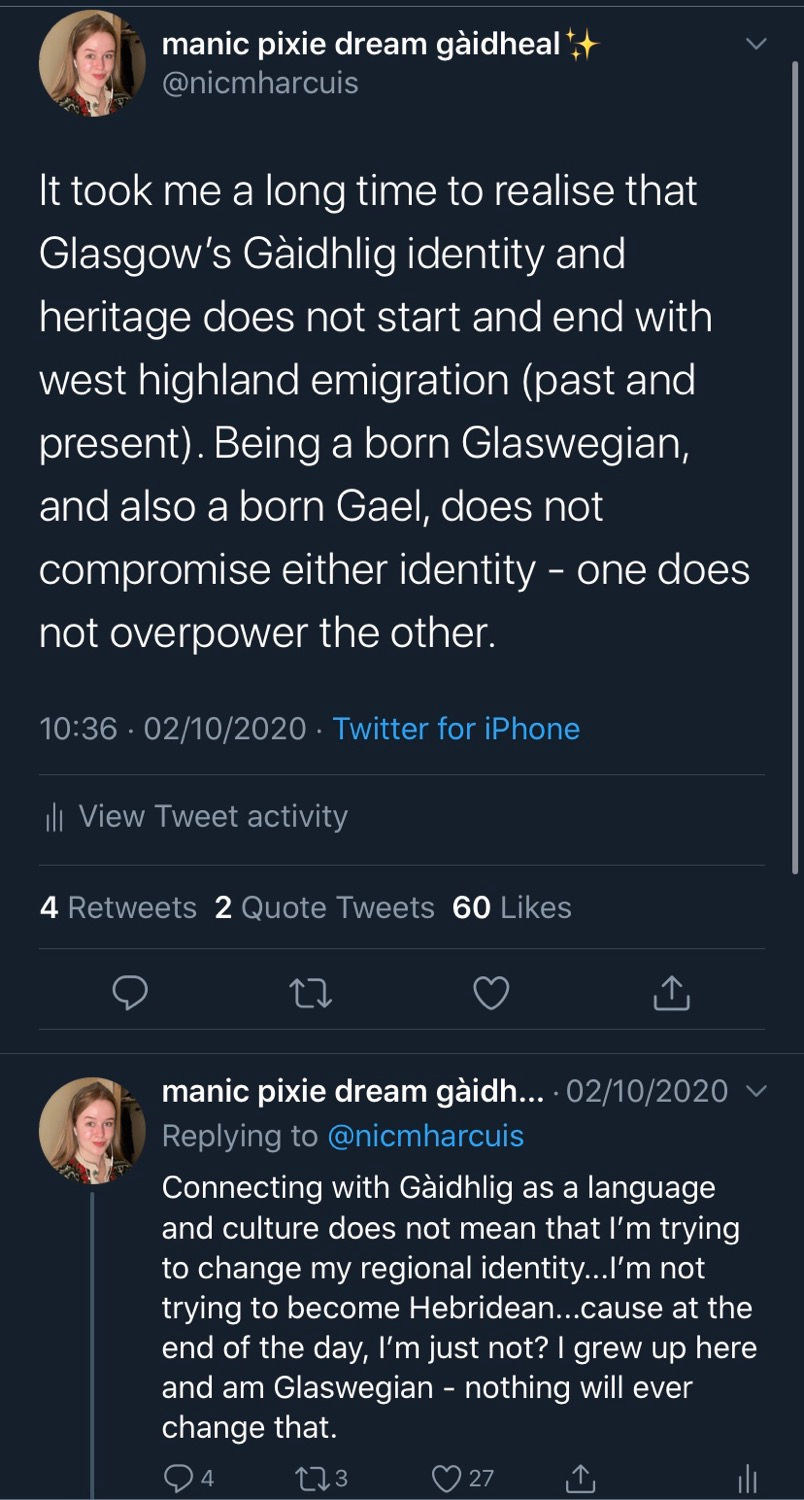
I typed them up on the spot without taking the time to further examine the topic, and I now realise that I have so much more I would like to contribute to the discussion (usual from me!). My sentiments stretch beyond what would be reasonable to write in the form of twitter thread, so here I am, on ye olde blog (how formal).
To start, let’s get one thing straight: I’m a bona fide city gal. Me and Glasgow are lifelong pals, a partnership even - I’m as much a part of this dear green place as it is of me.
Born and raised in the south side, here I’ve remained for all of my 18 years. I may be a first generation Glaswegian, but I am no less weegie than anyone who’s roots grow deeper beneath the city, into the bygone. I know no other life, I’ve lived no other reality.
My childhood was spent within red sandstone walls. Almost every free second I’ve ever had has been used to navigate the different quarters of the city, wander aimlessly around our many parks, wait for the subway or bankrupt myself somewhere along Buchanan street. I am aware of no greater feeling of pleasure than the cool relief of a tenement close on a hot summer day.
However, another equally dominant aspect of my identity is that I’m as inherently a Gael as I am a Glaswegian. I can recite Skippinish’s entire discography, album by album, just as effortlessly as I can every south Glasgow train timetable (seriously, try me).
But I must admit that I long struggled with this duality. From a young age we are all bombarded with an array of standardisations and over-simplifications, which we quickly internalise by observing depictions in the media and comparing the division of the government’s time, care and funding.
To young Rose, the message couldn’t have been clearer: these two facets of myself are nothing less than antonymic...
Glaswegian-ness is urban, Gaeldom is rural. Modernity vs tradition. Diversity vs homogeneity. Useful vs useless. Alive vs dead. South vs north.
...Struggling to find any common ground between the two worlds except Scotland itself, I felt perpetually suspended between two polars. To me, there appeared to be a very certain line drawn in the sand somewhere at the foot of Loch Lomond, separating the highlands and the lowlands - separating Glasgow and Gàidhlig.
Growing up, I noted that “Gaelic-ness” in Glasgow seems to be solely defined by where you “come from”. There is generally an assumption that any self-proclaimed Gael in these parts is originally from somewhere else - somewhere further north, somewhere more rural. Maybe you’re here for uni or work, either way, you’re an expat - your *real* home is not here, your instinctive lifestyle is not this one.
Therefore, I always felt that claiming Gaeldom as an aspect of my identity was compromising my Glaswegian-ness - branding myself as something less than native to my own home city. So, until recent years, Gael was a term that I was hesitant to actively label myself as.
And it must be said that this I also experienced this same clash of self in Gàidhlig environments - to an equal extent despite it manifesting in the opposite way. In these settings, I used to feel like my Glaswegian-ness made me less of Gael.
Scared that my duality weakened my Gaelic-ness, watered it down, I all too often felt the need to justify my identity by providing my “Gàidheal credentials” - my before, where I “come from”. And honestly, even now, I still do this (yay for imposter syndrome!). I’ll talk about my grandfather, my “islander side”. I’ll tell people about our island, Cara, and it’s links to Uist. I’ll list the names of him and his siblings: Donald-Bain, Mairi-McLeod, Flora-Bain, Dugald-McMillan...would I feel more secure in my identity if I had a name more akin to theirs?
This mindset in which I have participated only serves to further strengthen the narrative that Gàidhlig is the past, not the present.
My identity should not be reliant on previous generations - I am 100% Gael in and of myself.
My identity is solely dictated by the way I, as a self-determining individual, chooses to interact with my culture and language in the current day and not by the latitude and longitude of any fore-passed ancestral homelands of mine.
Of course, my relationship with Gaeldom is heavily informed by where my family, where I, hail from. But that’s so far from being the whole story, Glasgow has arguably been an equal, if not greater, influencer.
And how could it not? My city, Baile Mòr nan Gàidheal, is home to the largest population of Gàidhlig speakers out with of the Western Isles themselves. Our Gaelic character is innate, not imported. Nor is it defined by or dependant on west highland diaspora.
The presence of our tongue and traditions in this city is not limited to the run of Celtic connections or confined to the boundaries of sgoil Ghàidhlig or the park bar.
Although the etymology of Glasgow is Brittonic, Glaschu still long predates the English translation. Glasgow was Gaelic before the industrial revolution, before the shipyards, before the highland clearances, and yes...before. the. park. bar!!!
Connecting with Gàidhlig as a central-belter does not mean that I’m trying to change my regionality, or convert to hebrideanism. I neither need nor want to when my birthplace has it’s own vibrant heritage and promising future with the language.
I’m not trying to integrate myself into a culture I was born to; a Glasgow Gael identity is no less worthy, no less rich, no less pure, no less Gael than a Hebridean one.
In reflection, it upsets me that I ever felt the need to dissect and compartmentalise myself the way I used to. It took 18 years for me to learn that we, as humans, are not a zero-sum game - we are naturally multifaceted. The presence of one trait does not compromise the validity or wholeness of any others.
These two parts of me are not in opposition! In-fact, they only serve to inform and complement one another - my Gàidhlig is Glaswegian and my Glaswegian-ness is Gàidhlig.


Comments